Module 06 of 10 · The practice
Your Own Node
Verify your own chain; ask no one's permission.
On the tenth of January 2009, a cryptographer in California posted two words that became the job description for everyone who followed: "Running bitcoin". Hal Finney had downloaded the software the day Satoshi released it, and what he was running was not an app or an account — it was a full node, independently checking every rule of a brand-new money against every block, trusting nothing he had not verified himself. Sixteen years on, most holders have quietly outsourced that job back to somebody else's server, and with it the two things a node actually delivers: the right to verify, and the privacy of not asking.
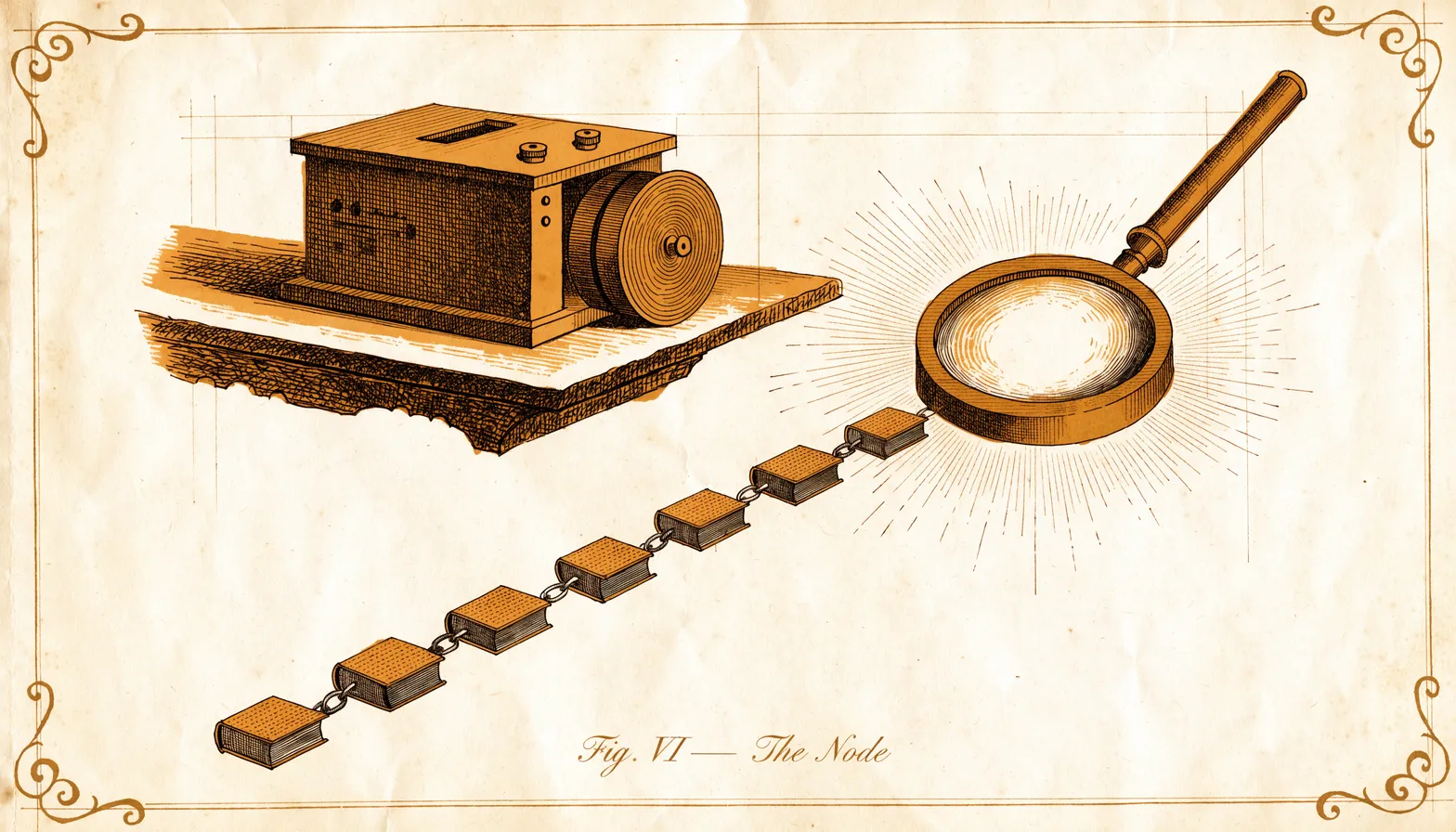
Be clear what a full node is: software — Bitcoin Core, almost always — that downloads every block ever mined and checks all of it against the consensus rules. Every signature valid, every coin's history unbroken, no inflation beyond schedule, before your node accepts a single block. It is not mining, needs no special hardware, and holds no coins. It is the difference between reading the ledger with your own eyes and having it read to you by someone you have chosen to believe.
Because here is what wallet software does without one: it asks a server. Every balance check, every "confirmed" tick, every broadcast goes through somebody else's machine — and that machine learns your addresses, links them together, ties them to your IP address, and could, on a bad day, lie to you by omission: show a stale balance, not relay your transaction, not mention a payment. The server operators are mostly honest. The point of this school is that mostly honest is precisely the standard bitcoin was built to make unnecessary.
The privacy cost is the one holders underrate. A watch-only wallet that queries a public server hands over the full address list of the wallet it watches — which is a complete, timestamped map of your holdings, attached to your IP, sitting in a log you will never see. Module 2 taught you to keep your home address out of a vendor's database; querying someone's server with your entire wallet is the same leak, repeated at every refresh. Your own node closes it flatly: the addresses never leave the house.
A node is also your vote for what bitcoin is. The rules are enforced by the network of verifying nodes — a block that breaks them is simply rejected, whoever mined it, however much hashpower stood behind it. Satoshi remarked in 2010 that the core design was set in stone for the rest of its lifetime; the stone is the quiet grid of machines that check. Running one adds your household to that grid: nobody can show you a fake bitcoin, and your node relays only what you consider valid.
Practically, the bar is low: a spare machine or small single-board computer, a 2 TB SSD, a patient initial sync, and either Bitcoin Core by hand or a guided node OS — the printable First-Time Node Runner attached to this module walks the whole sequence. The step that matters most comes last: point your wallet at it and disconnect from public servers, because a node your wallet ignores is a hobby, not an upgrade. Run it over Tor and the last observer — whoever watches your connection — loses the thread too. From then on your keys sign, your node verifies, and nobody else is in the room.
Field document · Printable
Take this module off-screen.
An A4 handout to print, mark up, and keep with your custody records — seeds and worksheets belong on paper, not screens.
Free account required
“Running bitcoin”
“The nature of Bitcoin is such that once version 0.1 was released, the core design was set in stone for the rest of its lifetime.”
Reading ladder
Climb at your own pace.
Sign in to check off reads
Beginner
Inventing Bitcoin
Yan Pritzker · 2019
What the network is actually agreeing on — the thing your node will verify.
Intermediate
The Internet of Money
Andreas M. Antonopoulos · 2016
Why verification, not trust, is the cultural core — the case for running your own.
Deep
Mastering Bitcoin
Andreas M. Antonopoulos · 2017
The network and consensus chapters: what Bitcoin Core is doing block by block.
Field test
Take the quiz. Track the curriculum.
The module text is open to everyone, no account needed. The 3-question field test and the curriculum-wide graduation stamp need a free account so we can record your progress.
Registration takes an email or a Nostr key, and either way 7 days of VIP come with it.