Module 05 of 10 · The practice
Airgapped Signing
Keys that never touch a connected machine.
The centrifuge halls at Natanz were never connected to the internet. Iran's uranium-enrichment programme sat behind a true air gap — and in 2010 the Stuxnet worm wrecked its centrifuges anyway, carried across the gap on USB sticks by people just doing their jobs. Security engineers have told that story ever since, because it teaches the exact lesson bitcoin holders need before they buy an "airgapped" signer: the gap is not a property of the device, it is a discipline about what crosses it. Used well, an air gap is the strongest practical barrier a holder can put between their keys and the internet. Used as a talisman, it is a word on a product page.
Start with the mechanics. An airgapped signing setup splits the wallet in two: a watch-only wallet on your connected computer, which knows your addresses and balances but holds no keys and can sign nothing; and a signer that holds the keys and never connects to anything — no USB data, no Bluetooth, no WiFi. The two halves exchange only inert data: the online side builds an unsigned transaction, the offline side signs it, and the signature travels back. Malware on your laptop can watch everything and steal nothing, because nothing on the laptop can spend.
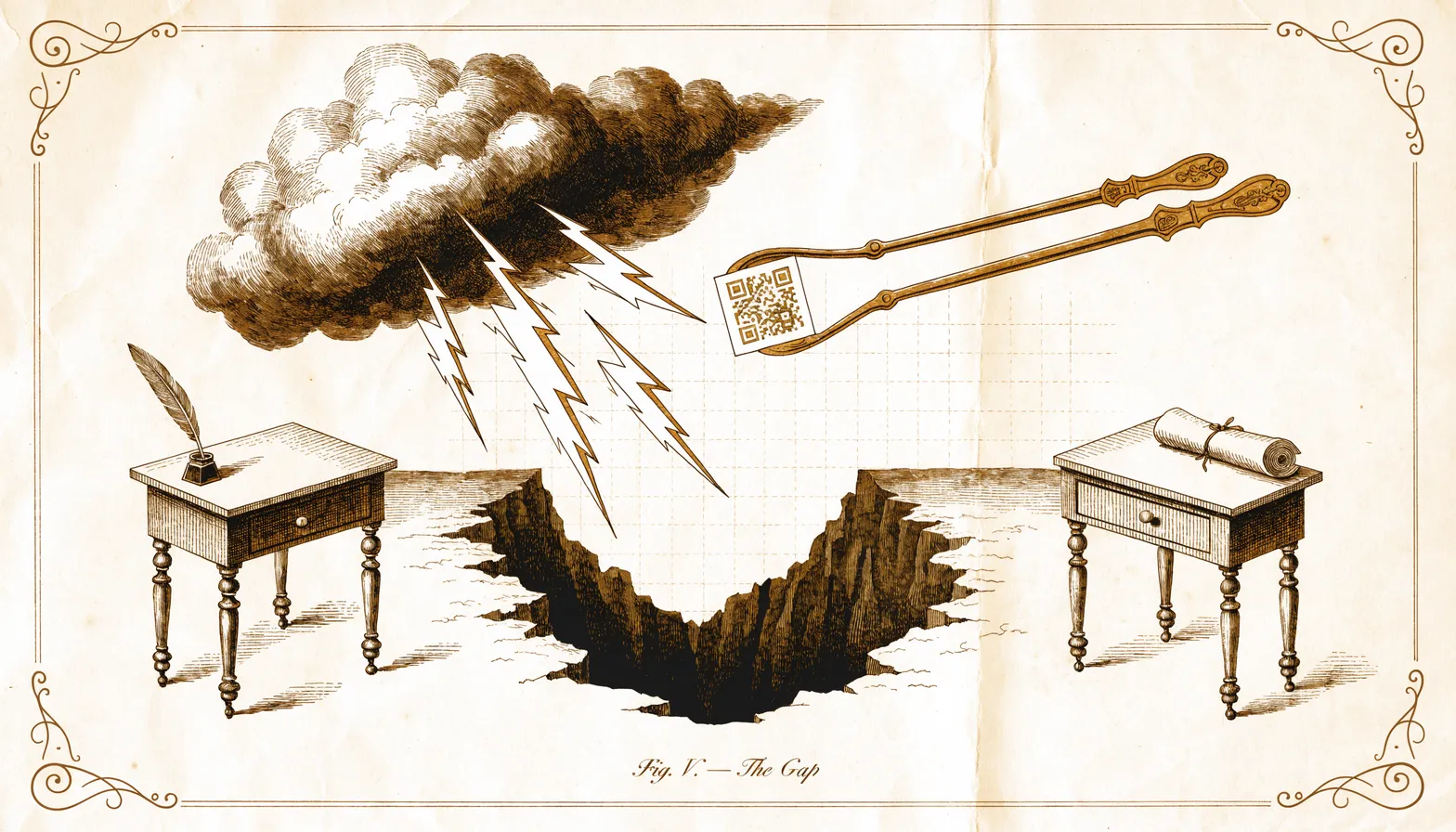
The courier between the halves is the PSBT — the partially signed bitcoin transaction, a standard container that carries a transaction across the gap by QR code or SD card. This is where the gap earns its keep: a QR code is a narrow, auditable channel. It carries exactly the payload it displays, cannot probe the device it is shown to, and both sides can inspect what crossed. Compare a USB cable, which connects two computers' full software stacks — drivers, firmware, protocol parsers — every layer of which is attack surface that has nothing to do with the transaction. Narrowing the channel is the whole design.
The workflow, end to end: build the transaction in the watch-only wallet; carry the unsigned PSBT across the gap; read every detail on the signer's own screen — destination, amount, fee, change — and only then approve; carry the signed result back and broadcast it. The verification step is not optional ceremony. The signer's screen is the one display in the room that malware on your computer cannot draw on, which makes it the only place a transaction can be trusted as read. An airgapped signer approved blind is a very expensive rubber stamp.
Now the Stuxnet lesson, honestly applied. The gap is only as good as what crosses it: an SD card is itself a small computer with firmware, and a QR workflow is only as trustworthy as your habit of actually reading what is displayed. And the gap does nothing about failures that were born offline. The Cipher School's entropy module documents an airgapped, security-first device whose broken random number generator cost holders over a thousand BTC — no connection required, because the flaw shipped in the box. Airgapping removes the network attacker; it does not audit your vendor, verify your entropy, or back up your seed. Those disciplines stack; none substitutes for another.
Practically: this is the natural next rung after Module 2's hardware doctrine. Devices built for QR-first signing keep the channel narrow by construction, and stateless designs — which hold no seed at all until you present it, then forget it at power-off — remove even the resting device as a theft target, at the cost of entering the seed each session. Whichever tool you choose, rehearse the loop with pocket change first: build, carry, read, sign, return, broadcast. The gap protects the keys; the rehearsal protects you from the gap's real enemy, which is your own improvisation on the day it matters.
Hands on
Try it yourself.
INTERACTIVE · THE SETUP LADDER
Where are you on the climb?
Tick only what you have genuinely drilled — bought is not built. One rung at a time, funded small, until the drill is boring.
Coins on your own signing device, seed on stamped metal in two places — and you have wiped the device and recovered from the steel alone.
A BIP39 passphrase with its own written backup, stored apart from the seed — and a small-value recovery test has proven both halves.
Keys on a signer that never connects; PSBTs cross by QR or SD card; every spend is read on the signer's own screen before approval.
A full node you run, with your wallet pointed at it and public servers disconnected — your addresses no longer leave the house.
A 2-of-3 across vendors and buildings, descriptor backed up everywhere a key is, with a spend AND a two-key recovery both rehearsed.
A sealed letter that points without containing, an executor who has walked the plan end to end, and an annual review in the calendar.
“The only truly secure system is one that is powered off, cast in a block of concrete and sealed in a lead-lined room with armed guards — and even then I have my doubts.”
Reading ladder
Climb at your own pace.
Sign in to check off reads
Beginner
Inventing Bitcoin
Yan Pritzker · 2019
What a signature actually is — the thing the airgap exists to protect.
Intermediate
10x Security Bitcoin Guide
Michael Flaxman · 2020
A complete airgapped, multi-vendor signing procedure in practice.
Deep
Mastering Bitcoin
Andreas M. Antonopoulos · 2017
Transactions and signing from first principles — what a PSBT is carrying.
Field test
Take the quiz. Track the curriculum.
The module text is open to everyone, no account needed. The 3-question field test and the curriculum-wide graduation stamp need a free account so we can record your progress.
Registration takes an email or a Nostr key, and either way 7 days of VIP come with it.