
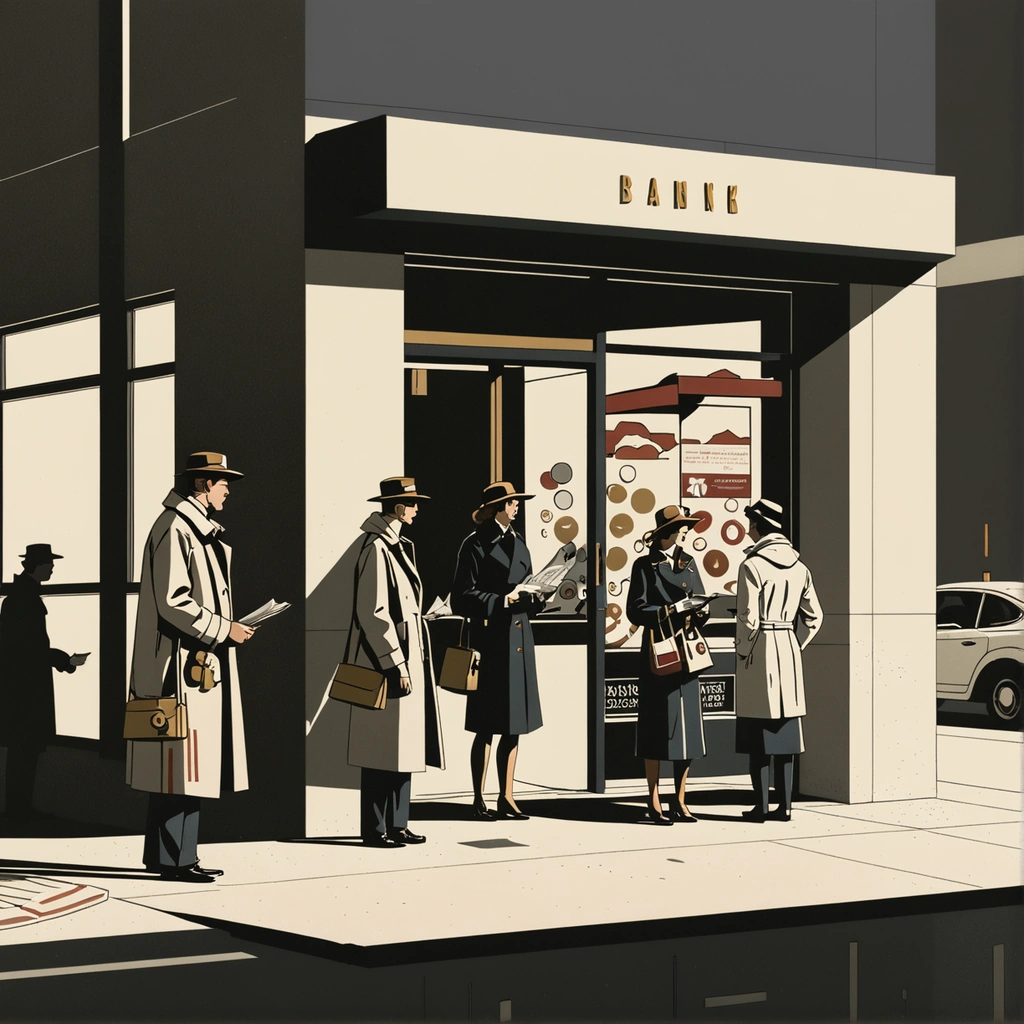
In September 2007, depositors queued around the block outside Northern Rock branches, the first run on a British bank since 1866. Here is the strange part: most of them were not withdrawing money so much as converting it. The number in a Northern Rock account was one kind of money: a private company's IOU, only as good as the company. The twenty-pound notes they walked out with were another kind entirely, a liability of the Bank of England, good even if every high-street bank in the country went to the wall. The queue existed because, for one nervous week, Britain remembered these are not the same thing.
Start with what your bank balance actually is. It is not money sitting in a vault with your name on it, and it is not money the bank is 'holding' for you. It is an entry in the bank's ledger recording that the bank owes you money: a debt, payable on demand. When you tap a card, no money moves in any physical sense; you instruct one bank to reduce its debt to you and another to increase its debt to the shopkeeper. The everyday money of the economy is a circulating web of private IOUs, and the high-street banks that issue them are (whatever the marble lobbies once suggested) leveraged private companies that can and occasionally do fail.
The second kind of money is the kind you can never hold. Commercial banks keep accounts at the Bank of England, and the balances in those accounts (reserves) are central bank money, along with the notes in your wallet. Reserves are how banks settle with each other: when your salary moves from your employer's bank to yours, the two banks square the difference in reserves across the Bank of England's own ledger. You cannot open a reserve account. Neither can Tesco, nor your pension fund. Reserves are a members-only money for the banking club, and the banknote in your pocket is the only central bank liability the public is permitted to touch.
This is a hierarchy, not a partnership. At the top sits the settlement asset: central bank money, which extinguishes a debt finally and completely. Below it sit promises to pay that asset: your deposits. Perry Mehrling's observation that monetary systems are always hierarchical is not a metaphor; it is visible in the plumbing. And the proportions are startling. By the Bank of England's own 2014 reckoning, notes and coin made up about 3% of the money circulating in the UK economy; roughly 97% was commercial bank deposits. The stuff the public calls 'pounds' is overwhelmingly the lower tier: bank IOUs denominated in pounds, resting on a base layer most people will never see or touch.
Why does the distinction matter? Because when a bank fails, the only question is which kind of money you were holding. A tenner survives the failure of every bank in Britain; a deposit becomes a claim on the wreckage. What makes deposits feel like money is machinery: FSCS insurance up to £85,000, the Bank of England standing behind the payment system, and on-demand convertibility at par. That one-for-one peg between the two monies is a policy construct, not a law of nature; the Northern Rock queue was simply people climbing the hierarchy while the ladder held. None of this is a scandal; it is the design. But you cannot reason honestly about banking, bail-outs or Bitcoin until you see that 'money in the bank' is a metaphor.
“Broad money is made up of bank deposits — which are essentially IOUs from commercial banks to households and companies — and currency — mostly IOUs from the central bank.”
“Of all the many ways of organising banking, the worst is the one we have today.”
“Always and everywhere, monetary systems are hierarchical.”
READING LADDER
Climb at your own pace.
FIELD TEST · SIGN-IN REQUIRED
Take the quiz. Track the curriculum.
The module text is open to everyone: no account required to read. The 4-question field test and the curriculum-wide graduation stamp need a free account so we can record your progress.
SIGN IN TO TAKE THE QUIZFREE · NEW ACCOUNT TAKES 30 SECONDS