

Pick up a pencil. A simple object. Six inches of cedar wood, a graphite core, a brass ferrule, a pink eraser. Now answer this: who knows how to make one? Not how to assemble the parts. That's the easy bit. Who knows how to fell the cedar tree, mine the graphite, smelt the brass, vulcanise the rubber, harvest the pumice that goes in the eraser, run the railway that transports the components, write the insurance contracts that cover the freight? Nobody. Not one human being on Earth knows how to make a pencil. And yet pencils exist, by the billion, for pennies. How?
This is Leonard Read's I, Pencil (1958), and it's the most powerful illustration of Friedrich Hayek's central insight: the knowledge required to coordinate a modern economy is not held by anyone. It is dispersed across billions of human minds, each holding tiny fragments: what's in the warehouse, what the customer wants, what the weather will do tomorrow, what the local labour market looks like. No board, no ministry, no AI can aggregate it, because most of it isn't even articulable. It's tacit. Local. Constantly changing.
The miracle of the price system, Hayek argued in The Use of Knowledge in Society (1945), is that it doesn't need to aggregate that knowledge. Prices summarise it. When tin becomes scarce somewhere in the world (for any reason: a mine collapse, a new use, a trade route closure), the price of tin rises. Every tin user on Earth instantly receives the signal: economise. Substitute. Reroute. They don't need to know why. They just need the price. The system is a vast, distributed information processor, and prices are its messages.
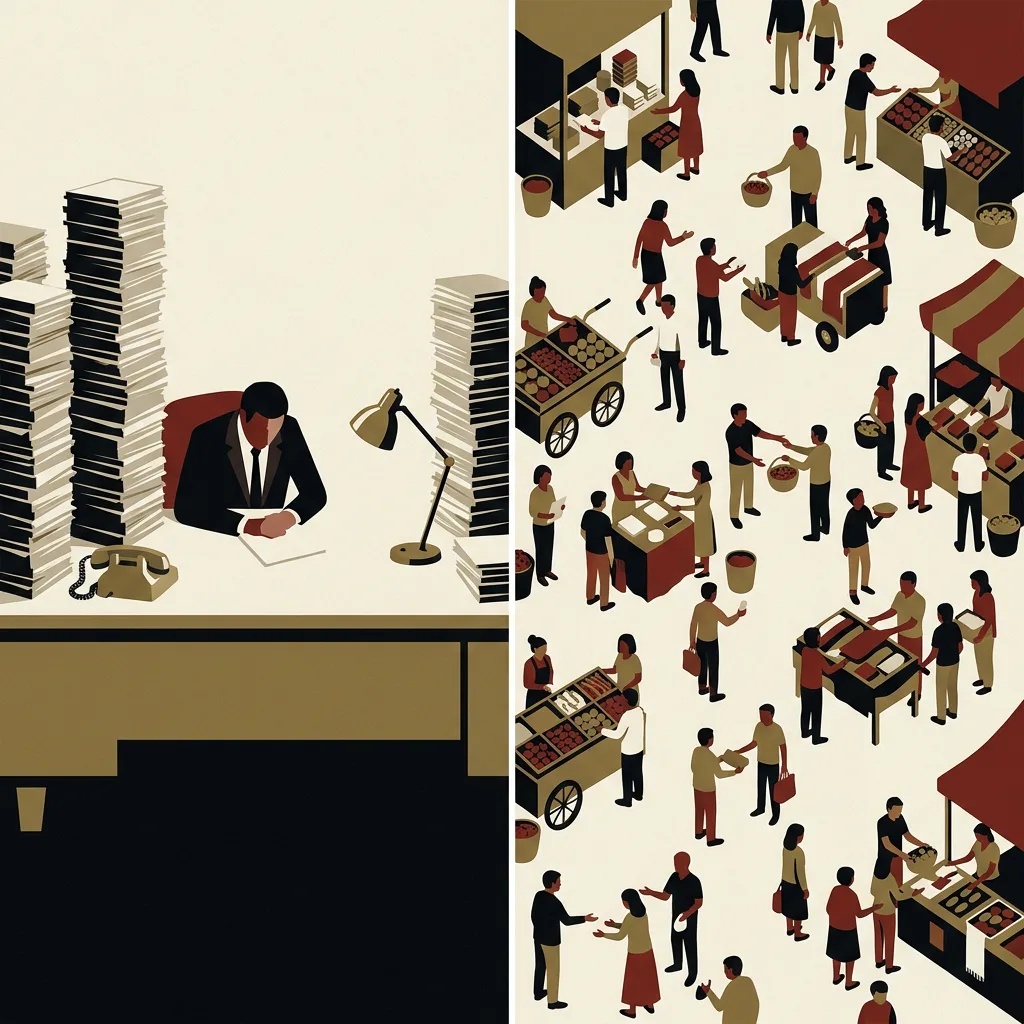
Mises had made the harder version of this argument in 1922: under socialism, where the means of production are owned in common, there are no prices for capital goods because there are no markets for them. Without prices, there is no way to calculate whether one use of resources is more valuable than another. The planner is economically blind. He may have all the engineering data in the world, but he cannot perform the basic calculation: is it better to make a thousand more tractors or a hundred more refrigerators? There is no answer without prices, and there are no prices without markets.
This is why every attempted socialist experiment of the 20th century descended into shortages, surpluses, queues, and black markets. The black markets weren't a bug: they were the system desperately reinventing the price mechanism it had abolished. The interactive below makes the point in 30 seconds: try to set prices for five goods by central command, then switch to a free market and watch equilibrium emerge.
“The curious task of economics is to demonstrate to men how little they really know about what they imagine they can design.”
“The knowledge of the circumstances of which we must make use never exists in concentrated or integrated form, but solely as the dispersed bits of incomplete and frequently contradictory knowledge which all the separate individuals possess.”
“Where there is no free market, there is no pricing mechanism; without a pricing mechanism, there is no economic calculation.”
READING LADDER
Climb at your own pace.
FIELD TEST · SIGN-IN REQUIRED
Take the quiz. Track the curriculum.
The module text is open to everyone: no account required to read. The 5-question field test and the curriculum-wide graduation stamp need a free account so we can record your progress.
SIGN IN TO TAKE THE QUIZFREE · NEW ACCOUNT TAKES 30 SECONDS