
Peer-reviewed (Royal Society Open Science, 2019): the field's academic high-water mark, and it points away from scarcity
ORIGINATED BY Wheatley, Sornette, Huber, Reppen & Gantner — Royal Society Open Science, 2019
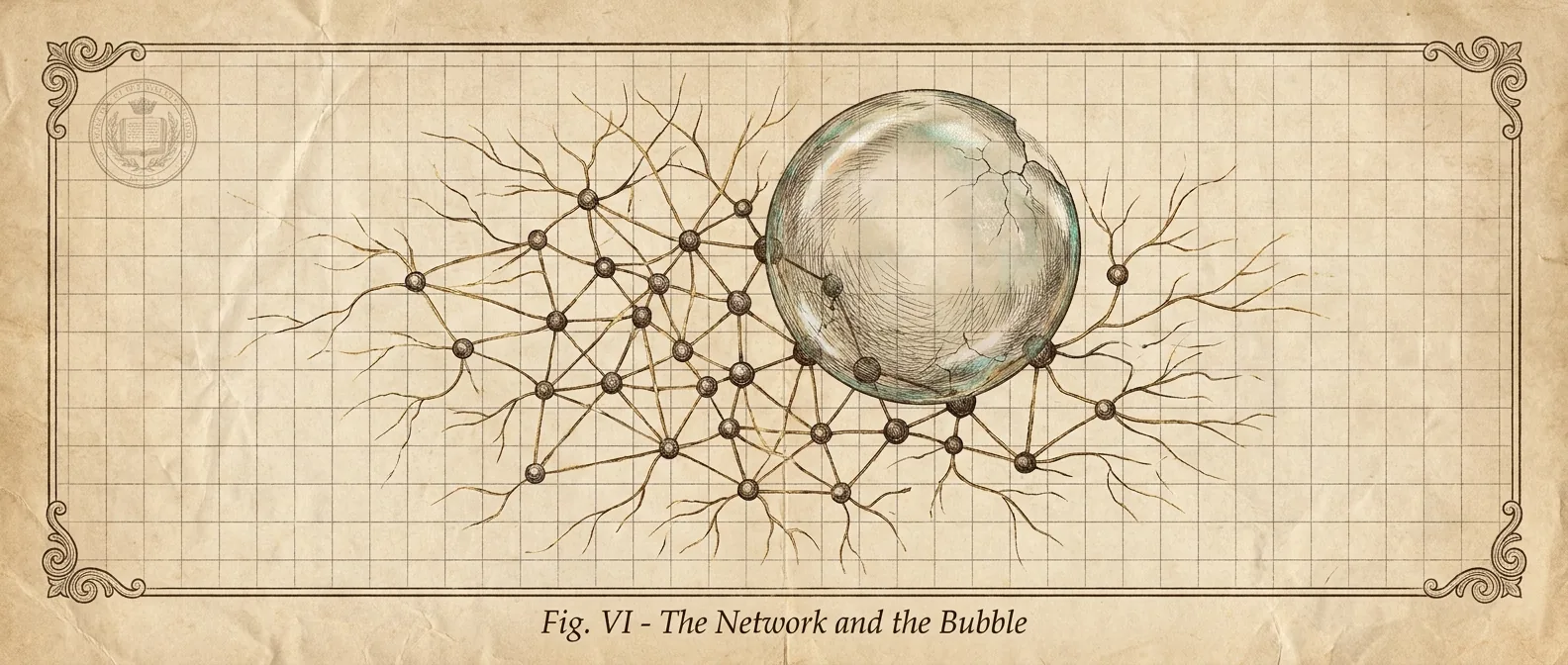
*A network is worth something because people are on it. That is the whole idea, and it is old: the telephone, the fax, the web all obeyed it. In 2019 a team led by Sornette, the physicist who spent a career forecasting crashes, turned the same lens on Bitcoin in a peer-reviewed Royal Society journal. Their verdict was double-edged: a fundamental value does exist, and it grows with the network of users. But it had been heavily exceeded, on at least four occasions*, by bubbles that grew super-exponentially and burst.
The paper fuses two instruments. The first is a generalized Metcalfe's Law. Robert Metcalfe's textbook claim was that a network's value scales with the square of its users: the number of possible connections among n nodes is roughly n². Applied to Bitcoin, the 'users' are proxied by active addresses, and the market capitalization is regressed against that count. Crucially, the authors do not impose the exponent of 2; they fit it, and the data prefer a gentler slope: β ≈ 1.69. Value still grows faster than linearly with the network, but a touch slower than n². That fitted exponent is the fundamental-value anchor.
The second instrument is the Log-Periodic Power Law Singularity (LPPLS) model, Sornette's signature tool for detecting bubbles. Its premise is behavioural: in a bubble, price does not merely rise, it rises faster than exponentially. Traders imitate each other, herding and momentum feed on themselves, and the growth rate itself accelerates toward a mathematical singularity: a critical time at which the trajectory becomes unsustainable. Superimposed on that acceleration are log-periodic oscillations, the fingerprint of a market oscillating with growing urgency as it approaches its breaking point.
Put the two together and you get a diagnostic rather than a price target. Metcalfe tells you where fundamental value roughly sits given the size of the network. LPPLS tells you when price has detached from any fundamental and entered a self-reinforcing, faster-than-exponential regime that historically ends in a crash. The paper reports that across Bitcoin's history these bubble regimes appeared and burst on at least four occasions, and that LPPLS gave ex ante (before the fact) warning of elevated crash hazard, along with a probabilistic bracket for when the correction was likely.
The intellectual significance is where this module earns its place in the academic wing. This is arguably the most rigorous valuation framework published on Bitcoin, and it explicitly frames network-based value as an alternative to scarcity narratives: the digital-scarcity, gold-analogy story from which stock-to-flow later grew. Its claim is that fundamental value flows from adoption, from real users transacting on the network, not from the supply schedule engraved in the protocol. Where scarcity models say the halving makes coins rare and therefore valuable, Metcalfe says a coin nobody uses is worth nothing regardless of how few exist. The two worldviews are not compatible, and the peer-reviewed one sides with users.
THE MATHS
Metcalfe (generalized): MarketCap ≈ 10^α · (active addresses)^β,  fitted β ≈ 1.69 (s.e. 0.0076), intercept α ≈ 1.51  (Metcalfe's textbook β = 2)
LPPLS (bubble regime): ln p(t) ≈ A + B(t_c − t)^m + C(t_c − t)^m · cos[ω ln(t_c − t) − φ]
  where t_c = critical time (crash hazard peaks), 0 < m < 1 (super-exponential), ω = log-periodic angular frequency
THE HONEST READ · LIMITATIONS
Where this indicator lies to you.
Start with the honest ceiling: Metcalfe's Law here is a regression, not a physical constant. The fitted exponent β ≈ 1.69 is chosen by ordinary least squares to best explain the history that already happened. 'Active addresses' is itself a fragile proxy: one user can control thousands of addresses, exchanges batch millions of users behind a handful, and address counts can be inflated or deflated by protocol changes, consolidation, and spam. If your measure of 'users' is noisy, so is every fundamental value you derive from it. Treat the anchor as an order-of-magnitude sketch, never a fair-value line to trade against.
LPPLS carries the deeper danger: hindsight fitting. A flexible model with a critical time, a power-law exponent, and an oscillation frequency can be tuned to fit almost any past run-up, and bubbles are gloriously visible after they pop. The real test is genuine out-of-sample forecasting, and here even the authors are careful: they stress that LPPLS quantifies crash hazard and a probabilistic bracket for the crash window, not a date. As the paper itself concedes, the precise trigger (which straw breaks the camel's back) is exogenous and unpredictable. A model that tells you a crash is likely 'sometime in the coming months' is useful, but it is not a timing machine, and anyone selling it as one has misread the mathematics.
Finally, the sample is small and the regime keeps changing. Four bubble episodes is a handful of data points on which to calibrate a universal law, and Bitcoin's market of 2013 (thin, retail, exchange-fragile) is a different animal from today's ETF-wrapped, institution-held market. A relationship fitted across those eras may not survive into the next. The intellectually honest posture is the one the authors model themselves: this is among the best-validated valuation frameworks we have for Bitcoin, and it is still a probabilistic diagnostic with real overfitting risk, not a verdict. Its lasting contribution may be less the exact number and more the argument that value lives in the users, which quietly undercuts the scarcity story it was published against.
“Using a generalized Metcalfe's law based on network properties, a fundamental value is quantified and shown to be heavily exceeded, on at least four occasions, by bubbles that grow and burst.”
“The LPPLS model is shown to provide an ex-ante warning of market instabilities... although, as always, the precise time and trigger (which straw breaks the camel's back) [is] exogenous and unpredictable.”
THE CITATIONS
Read the sources. Check our work.
FIELD TEST · SIGN-IN REQUIRED
Take the quiz. Track the curriculum.
The module text is open to everyone: no account required to read. The 4-question field test and the curriculum-wide graduation stamp need a free account so we can record your progress.
SIGN IN TO TAKE THE QUIZFREE · NEW ACCOUNT TAKES 30 SECONDS