
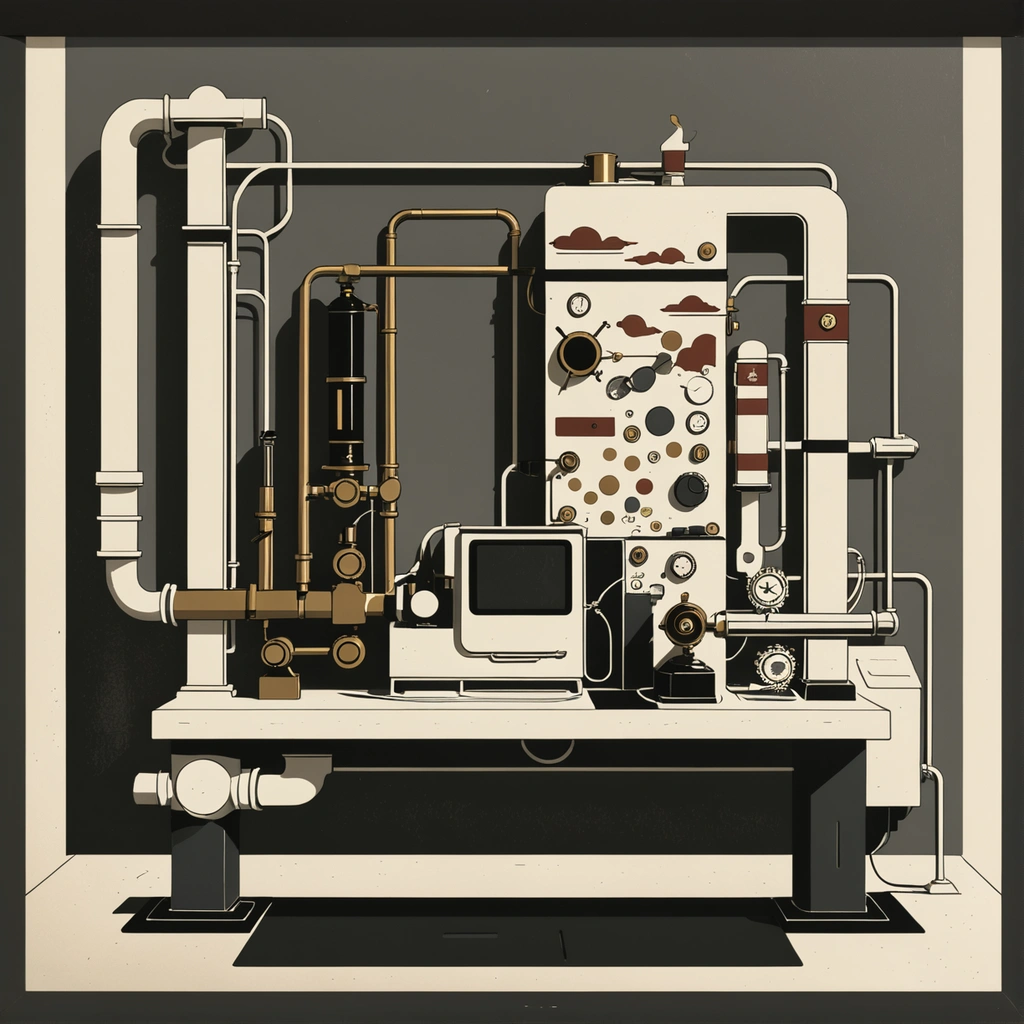
At noon on announcement day, the Bank of England publishes a number, and every headline says the same thing: the Bank has 'raised' or 'cut' or 'held' interest rates. The phrasing suggests machinery: a great brass dial in the basement of Threadneedle Street, turned by the Governor's steady hand. There is no dial. The Bank does not set the rate on your mortgage, your credit card, or your business overdraft, and never has. What it actually controls is one humble number: the interest it pays commercial banks on their reserve accounts. Everything else is herding, and the herd does not always go where it is driven.
Since 2009, Bank Rate has been, mechanically, the rate the Bank of England pays on reserves. That single administered price anchors everything through arbitrage. No bank will lend to another bank overnight for less than it can earn risk-free by leaving the money at the Bank; no bank with spare reserves needs to pay much more to borrow them. So the overnight market rate (SONIA, the rate at which banks actually deal) sits pinned within a whisker of Bank Rate, not because anyone is ordered to comply, but because deviating leaves free money on the table. The central bank moves one rate it pays on its own liabilities, and the herd shuffles across to stand beside it.
It was not always done this way. Before 2008 the Bank ran a corridor system built on scarcity: reserves were deliberately kept scarce, the Bank forecast the system's daily need, and it lent against gilts through repo operations to steer the overnight rate toward target: a penalty lending rate above, a deposit rate below, market rate herded between. Then quantitative easing drowned the scarcity. Buying hundreds of billions of gilts meant crediting banks with reserves on the same scale, and you cannot steer by rationing something you have made abundant. Hence the floor system: pay Bank Rate on the entire pile. The Fed's ample-reserves regime (interest on reserve balances plus the reverse-repo facility) is the same machine with American badging.
Transmission is where the herding metaphor earns its keep. Move Bank Rate and SONIA obeys within hours. Swap markets, pricing the expected path of policy, adjust fixed mortgage rates before the Monetary Policy Committee has even voted, which is why your two-year fix rose in 2022 while Bank Rate was still crawling. But further out, the signal degrades. Standard variable rates move when lenders please; savings rates follow cuts briskly and rises at a limp; SME overdrafts price off risk appetite as much as policy. Friedman's warning about long and variable lags still holds. A rate decision takes many months to reach the real economy, arriving unevenly and often after the conditions that justified it have changed.
Now the honest critique, which only lands because the description above is accurate. The interest rate is the price of time: the signal that coordinates society's saving with its investment. The Austrians, Hayek foremost, argued that when this price is administered rather than discovered, entrepreneurs receive a false signal (projects look viable that genuine savings cannot support), and the errors compound quietly into house-price manias, zombie firms, and the bust that follows. Note what the critique is not: there is no conspiracy, no printing press in the basement, no banker cackling at a dial. There is a committee, herding with skill and mostly good intent. It sets the most important price in capitalism by vote, eight times a year.
“Money will not manage itself, and Lombard Street has a great deal of money to manage.”
“It's not tax money. The banks have accounts with the Fed, much the same way that you have an account in a commercial bank. So, to lend to a bank, we simply use the computer to mark up the size of the account that they have with the Fed.”
“Monetary actions affect economic conditions only after a lag that is both long and variable.”
READING LADDER
Climb at your own pace.
FIELD TEST · SIGN-IN REQUIRED
Take the quiz. Track the curriculum.
The module text is open to everyone: no account required to read. The 4-question field test and the curriculum-wide graduation stamp need a free account so we can record your progress.
SIGN IN TO TAKE THE QUIZFREE · NEW ACCOUNT TAKES 30 SECONDS