
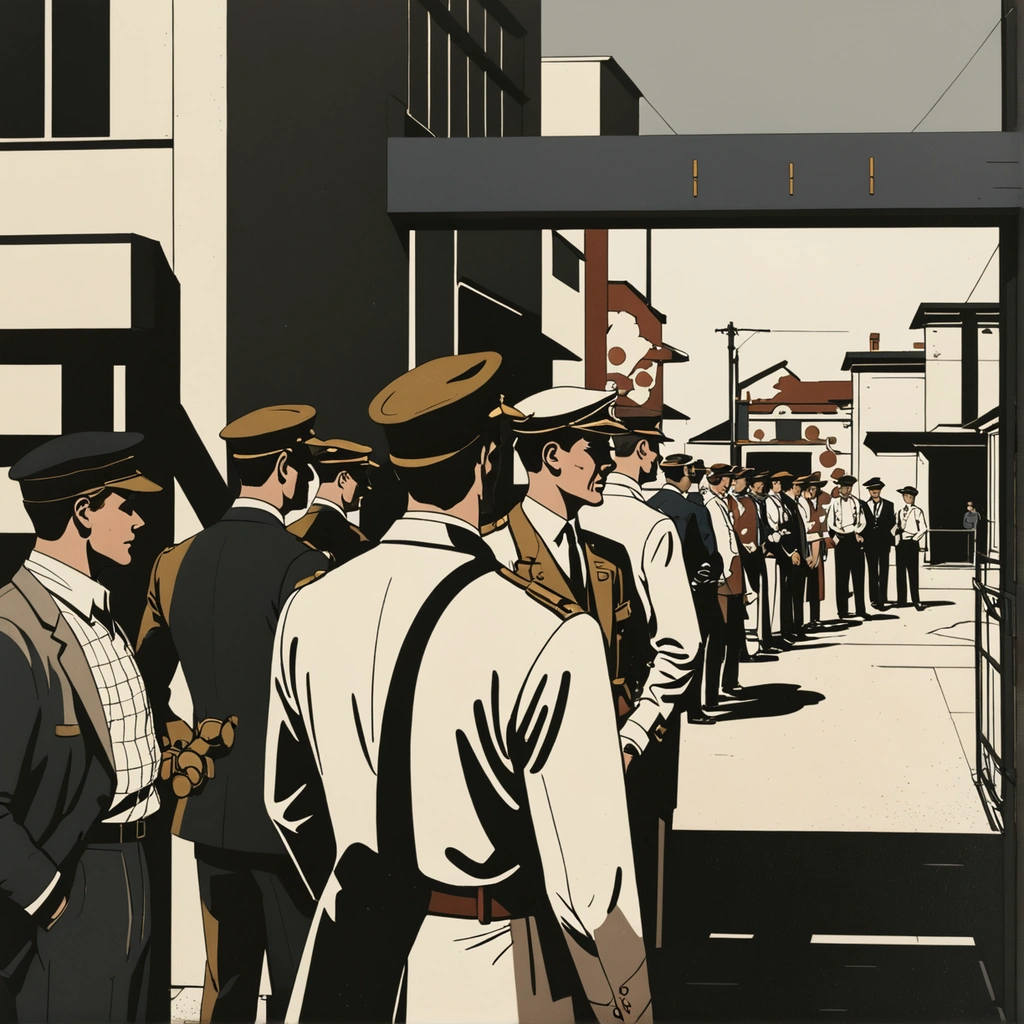
In 1936, with a quarter of Britain's industrial towns on the dole and factories standing cold behind locked gates, John Maynard Keynes published a book that would rewrite what governments believed they were for. The willing workers were there. The idle machines were there. The unmet needs were there. And yet the three would not come together, sometimes for a decade at a stretch. The older economists had an answer: wait, let wages fall, the market clears. Keynes looked at Jarrow and Wigan and asked the question that made him famous and dangerous in equal measure: what if it doesn't? What if an economy can get stuck, wanting for nothing but the nerve to spend?
Start with what Keynes actually saw, because it was real. In a monetary economy, where people hold cash rather than bartering goods directly, demand can fail. When fear rises, everyone tries to hoard money at once; but one person's spending is another's income, so the collective dash for safety shrinks the very incomes people are trying to protect. This is the paradox of thrift: prudent individually, ruinous in aggregate. And prices and wages, which the textbook says should fall until the market clears, are sticky; nobody volunteers for a pay cut, contracts are fixed, adjustment comes slowly and cruelly if at all. So the gap between what could be produced and what is produced does not close. It can sit open, with real people in it, for years.
Keynes' deeper move was to take expectations seriously as a cause, not a symptom. Investment, the engine of employment, depends on businessmen's guesses about a future no arithmetic can settle, guesses he called animal spirits. When confidence collapses, the collapse is self-fulfilling: firms do not invest because they expect weak demand, and demand is weak because firms do not invest. And the desire to hold cash (liquidity preference) can trap savings in idle balances rather than investment. Against this, Say's Law (that supply creates its own demand, that a general glut is impossible) looked complacent. A fair reading grants Keynes his point: mass unemployment in the 1930s was no fable, and telling those men to wait for wages to bottom out was neither humane nor, in a democracy, survivable.
Now the Austrian turn, and it begins by moving the crime scene. Keynes performs an autopsy on the slump and finds a demand shortfall. The Austrians, Hayek foremost in his 1930s duel with Keynes at the [LSE](https://mises.org/library/hayek-keynes-debate), reply that the slump is not the disease but the cure. The disease was the boom, when credit expansion pushed interest rates below the rate genuine savers required, and entrepreneurs, reading a false price of time, poured resources into long, capital-heavy projects no real savings could complete. The bust is the market discovering the mistake and liquidating it. Keynesian stimulus, by reflating aggregate demand, repairs nothing; it re-inflates the very malinvestments that need clearing. You do not fix a bridge built to the wrong plan by ordering more concrete.
The rest follows from one vice: aggregation blinds you. "Aggregate demand" and "the multiplier" collapse a time-shaped structure of capital (the half-built order that malinvestment distorts) into a lump-sum number, and a number cannot show you which projects were errors. Worse, Keynes promised symmetry (deficits in the slump, surpluses in the boom), but the politics are asymmetric: spending buys votes, cutting loses them, so the deficits proved permanent and the surpluses never came. And the demand manager needs precisely the knowledge the aggregates destroy. Concede the honest part, though: Keynes was right that money is no veil and demand failures are real, and the Austrian tradition's weakest joint was underrating secondary deflation, the collapse a pure liquidationist ignores. Saying so is the price of an autopsy over a hatchet job.
“The long run is a misleading guide to current affairs. In the long run we are all dead. Economists set themselves too easy, too useless a task if in tempestuous seasons they can only tell us that when the storm is long past the ocean is flat again.”
“Demand is effective by definition. If it is not effective, it is not called demand but need, desire, wish, or longing.”
“To combat the depression by a forced credit expansion is to attempt to cure the evil by the very means which brought it about; because we are suffering from a misdirection of production, we want to create further misdirection — a procedure which can only lead to a much more severe crisis as soon as the credit expansion comes to an end.”
READING LADDER
Climb at your own pace.
FIELD TEST · SIGN-IN REQUIRED
Take the quiz. Track the curriculum.
The module text is open to everyone: no account required to read. The 4-question field test and the curriculum-wide graduation stamp need a free account so we can record your progress.
SIGN IN TO TAKE THE QUIZFREE · NEW ACCOUNT TAKES 30 SECONDS