
On the morning of 3 January 2009, The Times of London carried a front-page headline: Chancellor on brink of second bailout for banks. Somewhere that day, a programmer working under the name Satoshi Nakamoto compiled that sentence — character for character — into the first block of a new ledger. Block 0 of Bitcoin exists nowhere in particular and everywhere at once, copied tonight across tens of thousands of machines, and the headline is still inside it. It serves two purposes. It proves the block could not have been made before that date, the way a hostage photograph proves the newspaper's date. And it states, without comment, exactly which problem the new ledger was built to escape: money that survives only by rescue.
Start by discarding the picture of digital coins moving between digital wallets. There are no coin files. A bitcoin is an entry in a ledger — a record of who may spend what — and the ledger is the whole system. What makes it unusual is where it lives: not in one institution's database but replicated in full across every full node on Earth, tens of thousands of independent machines each holding the complete history back to that January morning in 2009. When you "receive" bitcoin, no object arrives. The ledger gains a line saying that a certain amount may now be spent only by whoever can produce a particular signature. Ownership, here, means one thing: the ability to author the next valid update.
Why did this take until 2009? Because digital money has a defect physical money never had: perfect, free copying. Hand over a banknote and you no longer have it. Send a digital coin and you still hold every bit of it — nothing stops you sending the same coin to someone else. This is the double-spend problem, and it defeated digital cash for thirty years. David Chaum's ecash, built on his blind-signature work from 1982, solved it the only way anyone knew how: a central mint checked every transaction against its books. That worked, but it meant the mint saw everything, approved everything, and could fail — Chaum's company went bankrupt in 1998 and its money died with it. Every successor kept the same fatal ingredient: a trusted third party.
Bitcoin's actual invention is agreement without a privileged writer. On 31 October 2008, Satoshi announced to a cryptography mailing list "a new electronic cash system that's fully peer-to-peer, with no trusted third party" — nine pages, met mostly with scepticism. The paper did not appear from nowhere, and does not pretend to: its references cite Wei Dai's b-money and Adam Back's Hashcash by name, and Satoshi later credited Nick Szabo's bit gold. Each predecessor had a piece — proof that computation was spent, sketches of money without a mint — but each either kept a trusted party or stayed on paper. Bitcoin's contribution was making thousands of mutually distrustful strangers converge on one history of who owns what, with nobody holding the pen.
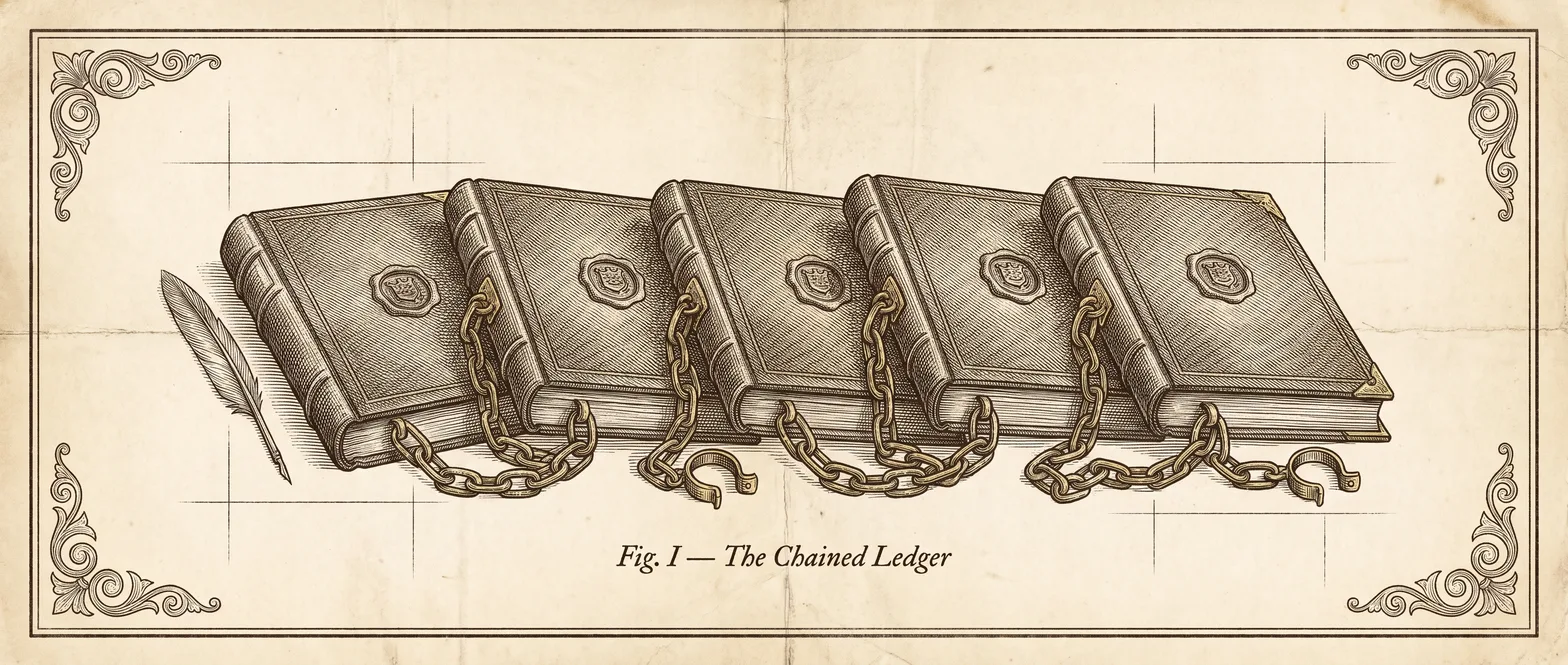
The ledger's history is held together by hashes. A hash is a fingerprint function: feed it any data and it returns a fixed-size number that changes utterly if a single bit of input changes. Transactions are batched into blocks, and every block's header contains the hash of the block before it. That one design choice makes the entire past tamper-evident. Alter a payment from 2015 and that block's hash changes; the next block committed to the old hash, so its own hash changes too, and the corruption cascades forward through every later block to the tip of the chain. Nothing prevents you editing your own copy of history — but every full node can detect, in microseconds, that your copy no longer matches the chain everyone else is extending.
Tamper-evidence solves half the problem. The other half is ordering: if the same coin is spent twice, which spend counts? Whichever came first — but "first" needs a clock nobody controls. Bitcoin's answer is proof-of-work. To add a block, a node must burn real electricity searching for a rare hash, and the network treats the chain embodying the most cumulative work as the true one. Forging an alternative history therefore means redoing that work faster than the honest world combined, so the record hardens with every block. This paragraph is carrying an entire module's weight — mining, difficulty and confirmation get their full treatment in Module 6. For now, hold the outcome: an ordering of events that is expensive to write and nearly free to verify.
Step back and the genesis headline reads as a thesis statement. The system being bailed out in that morning's Times ran on trust — trust that banks stay solvent, that ledger-keepers keep honest books, that the currency's issuer shows restraint. Satoshi named this directly: the root problem with conventional currency is all the trust required to make it work. Bitcoin replaces each trusted role with something checkable: a replicated ledger anyone can audit, hashes that expose tampering, proof-of-work that prices rewriting out of reach, and signatures — the subject of the next module — that let owners, and only owners, author updates. None of it requires believing anyone. That is the whole design brief, and everything else in this curriculum is one of its consequences.
INTERACTIVE · THE TAMPER-EVIDENT LEDGER
Edit any block’s transactions. Watch history refuse to lie quietly.
Each block’s fingerprint is a SHA-256 hash of its contents plusthe previous block’s fingerprint. Change one character anywhere and every later block’s stored link stops matching.
Here, repairing costs one click. On the real network it means redoing the proof-of-work for every block since your edit — while 600+ exahashes per second of honest competition keeps extending the version you are trying to outrun.
LESSON · TAMPER-EVIDENCE COMES FROM THE LINKAGE, NOT FROM SECRECY — EVERY HASH SHOWN IS SHA-256, TRUNCATED TO 12 HEX CHARS FOR DISPLAY
“I've been working on a new electronic cash system that's fully peer-to-peer, with no trusted third party.”
“The root problem with conventional currency is all the trust that's required to make it work.”
“Trusted third parties are security holes.”
READING LADDER
Climb at your own pace.
FIELD TEST · SIGN-IN REQUIRED
Take the quiz. Track the curriculum.
The module text is open to everyone: no account required to read. The 3-question field test and the curriculum-wide graduation stamp need a free account so we can record your progress.
SIGN IN TO TAKE THE QUIZFREE · NEW ACCOUNT TAKES 30 SECONDS