
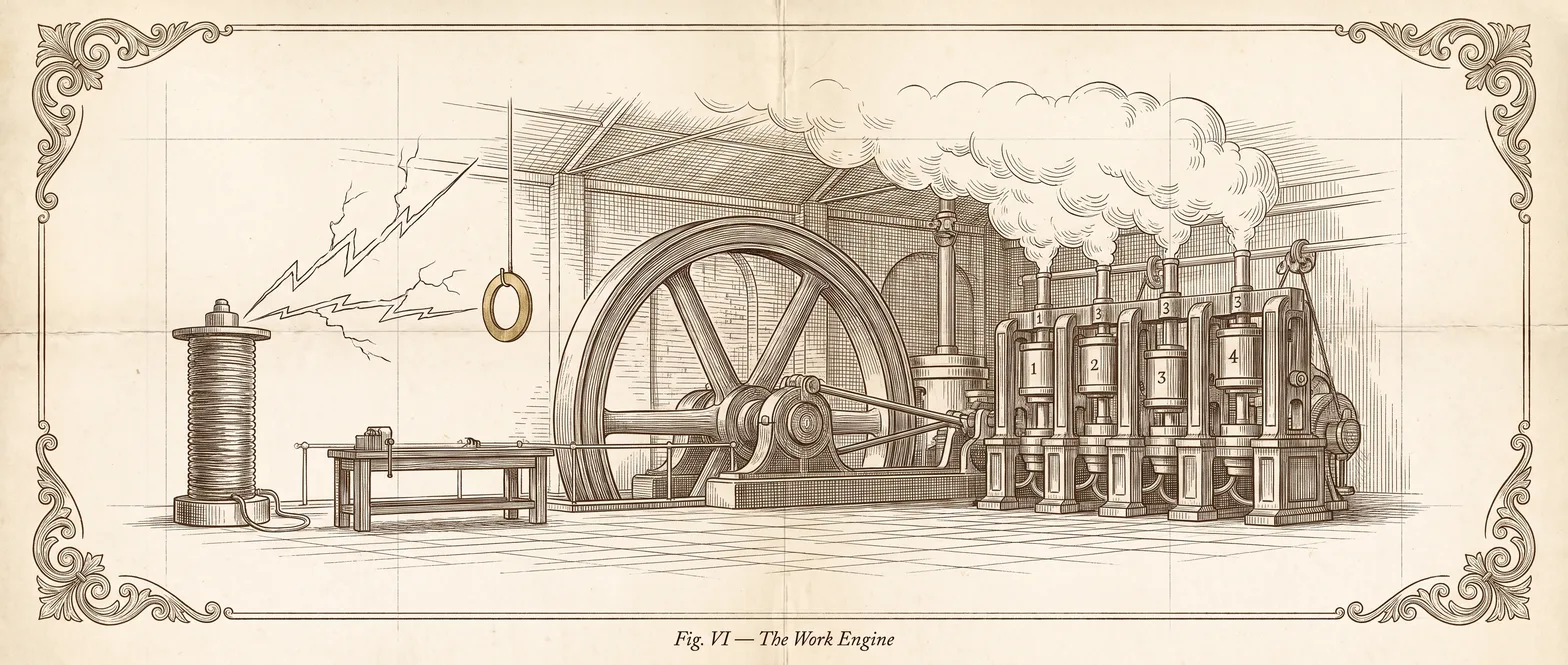
Eight days after the genesis block, a cryptographer in California posted ten characters to Twitter: "Running bitcoin". Hal Finney — PGP developer, the first person besides Satoshi to run the software — mined on his desktop for days, then switched it off because, as he later wrote, it made his computer run hot. The heat was not a side effect. It was the product. Every block Finney found was a receipt for electricity spent, and the network he helped boot has been converting watts into unrewritable history ever since — by 2026, at a scale of roughly 928 quintillion hash attempts every second. This module is about why the heat is the point.
Mining is a lottery in which the tickets are hash computations. A miner assembles candidate transactions into a block, then repeatedly hashes the block's 80-byte header — twice through SHA-256 — hunting a digest that falls numerically below the network's current target. Each attempt varies the nonce (and, once that four-byte space is exhausted in microseconds, values that reshuffle the merkle root) to produce a completely unrelated hash. There is no skill in it and no shortcut: SHA-256 gives no clue how close a guess came, so cleverness buys nothing and the only strategy is more guesses per second. In 2026 the network makes about 5.4 × 10²³ attempts per block found — a number of tickets so large that only electricity, at industrial scale, can buy them.
The rhythm never changes because the bar moves. Every 2016 blocks — roughly two weeks — every node recalculates the difficulty: if the last 2016 arrived faster than ten minutes apart, the target tightens; slower, and it eases (clamped to 4× in either direction). This is the thermostat that makes Bitcoin's issuance schedule-driven rather than demand-driven. When hashpower doubles, blocks briefly quicken — then the retarget doubles the difficulty and the ten-minute cadence returns, with twice the electricity now buying the same number of coins. More mining never mints faster. It only raises the price of each ticket, which is why difficulty has climbed from 1 at genesis to roughly 126 trillion today without a single coin being issued ahead of schedule.
Nodes follow the chain with the most accumulated proof-of-work — not the most blocks, the most expected hashes. That rule is what makes history expensive: to rewrite last week's ledger you must redo last week's work and then outrun every honest miner extending the real chain. Honesty pays the same hardware roughly 450 BTC a day in subsidy, plus fees; sabotage pays nothing and devalues whatever coins the attacker holds. Be honest about the limits, though: a hashpower majority can censor transactions or double-spend its own recent payments, the incentive argument assumes an attacker who wants Bitcoin to survive, and pools have breached the line before — GHash.io briefly exceeded 51% in 2014. But no amount of work makes an invalid block valid: a miner who prints extra coins is simply ignored by every full node, however many zeroes the hash carries.
The supply schedule is arithmetic, not policy. Each block's coinbase may create at most the current subsidy: 50 BTC at launch, halved every 210,000 blocks — to 25 in November 2012, 12.5 in 2016, 6.25 in 2020, and 3.125 since April 2024, where it stands today. The next halving lands at block 1,050,000, around April 2028. Sum the geometric series and, with satoshi rounding, total issuance converges on 20,999,999.9769 BTC — the famous 21 million is an asymptote, never quite reached, with the final satoshi of subsidy due around 2140. No committee meets to set these numbers, and no vote can change them without splitting the coin: every full node enforces the halving as a validity rule, and a block claiming too much is rejected like any other invalid block.
The energy question deserves one honest paragraph that runs both ways from the same source. Cambridge's CBECI estimates Bitcoin at roughly 138 TWh a year — about 0.5% of global electricity, some 39.8 Mt of CO₂e, plus ASIC e-waste and localised grid and noise burdens: a material footprint for a single application, and it is no answer to pretend otherwise. The same Cambridge survey work found about 52.4% of mining energy coming from sustainable sources, and mining's location-agnostic, interruptible nature lets it monetise stranded and curtailed generation that would otherwise go unused. Nor is the energy "wasted" in the engineering sense — it is precisely what makes the ledger's history expensive to rewrite. Both sides should concede what is real: the footprint, and the security it purchases. The argument is whether the service justifies the spend.
Years before Bitcoin, Nick Szabo asked why gold worked as money when prettier things did not, and answered with the idea he called unforgeable costliness: precious metals are believable stores of value because their creation cost cannot be faked — nobody can conjure gold cheaply and pass it off as dear. His bit gold proposal tried to give digital data that same property using proof-of-work, and Bitcoin is the design that completed the thought. A valid block hash is a certificate, checkable by anyone in microseconds, that quadrillions of attempts stood behind it. That is what the electricity buys: not tokens, but the physical impossibility of a cheap forgery. Digital scarcity was never the hard problem — copying is free. Costly history was the hard problem, and mining is its solution.
INTERACTIVE · PROOF OF WORK
Mine a block in your browser. Feel the odds.
| ZERO BITS | EXPECTED ATTEMPTS | AT YOUR RATE |
|---|---|---|
| 8 | 2^8 ≈ 256 | mine first to measure |
| 12 | 2^12 ≈ 4,096 | mine first to measure |
| 16 | 2^16 ≈ 65,536 | mine first to measure |
| 20 | 2^20 ≈ 1,048,576 | mine first to measure |
| 24 | 2^24 ≈ 16,777,216 | mine first to measure |
| ~76 | 2^76 — the real network, per block | …you don’t want to know |
» Difficulty retargets every 2,016 blocks so ten minutes stays ten minutes — more hashpower never mints coins faster.
“The majority decision is represented by the longest chain, which has the greatest proof-of-work effort invested in it.”
“The utility of the exchanges made possible by Bitcoin will far exceed the cost of electricity used. Therefore, not having Bitcoin would be the net waste.”
“Running bitcoin”
READING LADDER
Climb at your own pace.
FIELD TEST · SIGN-IN REQUIRED
Take the quiz. Track the curriculum.
The module text is open to everyone: no account required to read. The 3-question field test and the curriculum-wide graduation stamp need a free account so we can record your progress.
SIGN IN TO TAKE THE QUIZFREE · NEW ACCOUNT TAKES 30 SECONDS